
Orange rust stains on a Florida driveway, wall, or pool deck almost always come from iron in sprinkler water. The water looks clean when it leaves the head, but the dissolved iron turns into rust the moment it dries on your concrete, pavers, or paint. Rinsing rarely removes it, bleach can make it worse, and the stains come back unless the source is dealt with. This guide explains how to tell what you are looking at, what actually removes it, and how to keep it from returning.
Key takeaways
- Orange streaks in fan-shaped arcs near sprinkler heads are the classic sign of iron in irrigation water.
- Rinsing or pressure washing alone usually lightens these stains at best, because the rust settles into the surface instead of sitting on top of it.
- Bleach is an oxidizer, and on iron stains it can intensify the orange color instead of lifting it.
- Acid-based rust removers, such as products built on oxalic acid, are the usual fix, but the surface type, safety, and a test spot all matter.
- If the water is not treated or the spray is not redirected, the stains return the next time the sprinklers run.
Why do Florida sprinklers leave orange stains?
Much of Florida’s groundwater carries dissolved iron. In its guidance on irrigation systems, the University of Florida’s IFAS Extension notes that staining and scaling conditions exist once iron concentrations exceed 0.3 ppm, and that a review of groundwater in southwest Florida found iron ranging from 0.1 to 7.0 ppm. Many properties in Central Florida irrigate from private wells, so the same water that keeps the lawn green can also be carrying iron.
Dissolved iron is invisible and colorless. When the spray lands and the water evaporates, the iron reacts with oxygen and forms iron oxide, which is rust. Each time the sprinklers run, another thin layer is left behind. Over a season those layers build into the orange-brown coating you see on the lower few feet of a wall, along a driveway edge, or across a pool deck. Rain rarely lifts it, because the rust settles into the tiny pores of concrete, stucco, and masonry.
How to tell sprinkler rust from other stains
Not every dark or colored mark on your exterior is rust, and the wrong treatment can make the wrong stain worse. This quick comparison helps you sort out what you have.
| What you see | Most likely cause | Where it usually shows up |
|---|---|---|
| Orange or rust-colored arcs, often in fan shapes | Iron in irrigation water | Walls, driveways, sidewalks, and pool decks within reach of sprinkler heads |
| Brown or tea-colored streaks | Tannins from leaves, oak trees, and pine straw | Under trees and along roof-edge runoff paths |
| Black or green patches | Mildew, mold, or algae | Shaded, damp areas and north-facing walls |
| Rust spots with sharp, round edges | Rusting metal such as furniture legs, planters, or nails | Directly under the metal item |
A simple check is to compare the stains with your sprinkler pattern. If the marks line up with the spray, appear on the sides of the house closest to the lawn, and look worse after a stretch of irrigation, iron in the water is the likely culprit.
Why pressure washing alone usually does not fix rust stains
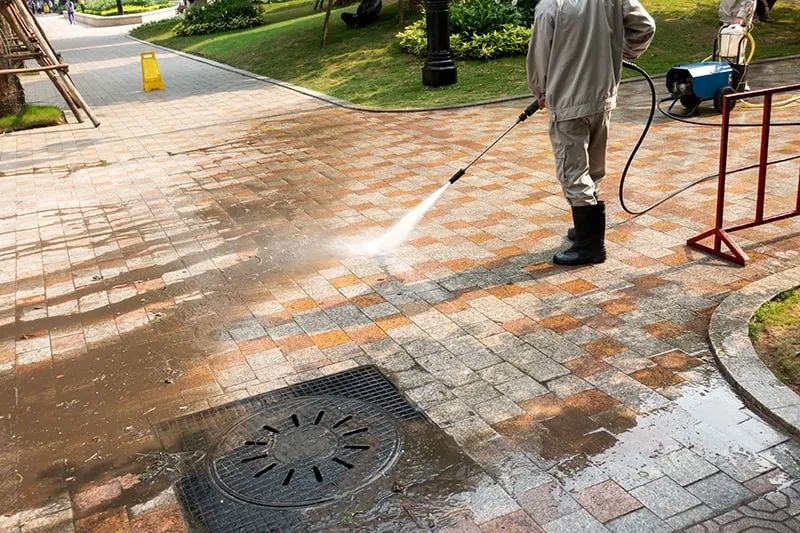
Rust is a chemical stain, not loose dirt. Pressure can knock off surface grime and may lighten a fresh stain, but it does not dissolve iron oxide. Turning the pressure up to chase a stain can etch concrete, scar softer surfaces, and push the rust deeper into the pores, which makes it harder to remove later. That is why rust removal is a chemistry job first and a pressure job second. If you want to understand how method choice affects different surfaces, our post on the difference between pressure washing and power washing covers the basics.
Why bleach can make rust stains worse
Many homeowners reach for bleach first because it works well on green and black growth. Rust is different. Bleach is a strong oxidizer, and iron stains are already the product of oxidation. On rust, bleach can deepen the orange color rather than remove it. Save bleach-based products for mildew and algae, and use a product made for rust when the stain is orange.
One safety rule matters more than any other here. Never mix bleach with an acid-based rust remover, because the combination can release toxic chlorine gas. Use one product at a time, and rinse the surface thoroughly with clean water before trying anything else.
What actually removes orange rust stains
Most rust removers for concrete, pavers, stucco, and siding rely on an acid that converts iron oxide into a compound that dissolves in water, so it rinses away. Oxalic acid is the best-known example, and many professional rust products are built on it or on similar chemistry. The process generally looks like this:
- Identify the surface. Concrete, brick, pavers, stucco, vinyl, painted surfaces, and natural stone all react differently to acids.
- Test a small, hidden spot. Apply the product, wait the labeled time, rinse, and look for dulling, etching, or color change before treating anything visible.
- Protect plants and nearby surfaces. Wet down landscaping first and rinse overspray right away.
- Apply the rust remover and let it work. Dwell time depends on the product and the depth of the stain, so follow the label.
- Rinse thoroughly with clean water. Leftover residue can cause problems of its own.
- Repeat on stubborn areas, then clean the whole surface. Deep or old stains may need a second pass, and a final wash gives an even look.
Acid products can irritate skin and eyes, so gloves, eye protection, and good ventilation are the minimum. Keep pets and children away until the area is fully rinsed. If you are not sure how a product will react with your surface, that is the moment to bring in a professional rather than experiment on a wall or a driveway you cannot easily replace.

Surface by surface: what to expect
- Concrete driveways and sidewalks. Usually the most forgiving. Heavy, long-standing stains can leave a faint shadow even after treatment.
- Pavers. Joint sand and sealers matter. If the pavers were sealed, rust removal can affect the sealer, so resealing may be part of the plan. Our guide to paver sealing and paver cleaning explains how the two work together.
- Stucco and painted walls. Porous and easier to mark. Harsh scrubbing or a strong acid can leave visible patches, so testing first is essential.
- Vinyl and aluminum siding. Usually respond well, as long as the product is rinsed off completely.
- Pool decks and cages. Stains often show up along the deck edge nearest the irrigation. Check the finish before treating, since some coatings react to acids.
- Natural stone. Some acids can etch certain stone, so it needs extra care and a test spot every time.
How to stop rust stains from coming back
Removal fixes the symptom. Prevention fixes the cause. If the water is the problem, these steps make the biggest difference, in roughly this order.
- Test your irrigation water. The UF IFAS Extension Soil Testing Laboratory in Gainesville offers water tests for irrigation and household water, usually from wells. The lab notes that its tests help diagnose potential problems in pipes and plumbing and are not a check of whether water is safe to drink. Private water labs offer similar testing.
- Treat the water before it reaches the sprinklers. UF IFAS Extension describes pretreating irrigation water as by far the best solution for avoiding iron problems in irrigation systems. Iron filtration and rust-inhibiting injection systems are common options, and an irrigation or water treatment professional can recommend what suits your well.
- Redirect the spray. Adjust heads and arcs so water does not reach the house, the driveway, or the pool deck. Even small changes can cut the amount of iron-bearing water that lands on hard surfaces.
- Clean early. Light, recent staining is far easier to remove than years of layered buildup.
Frequently asked questions
Will rain or time wash the orange stains away?
Rarely. The rust settles into the surface, so rain does not lift it, and new layers add to the old ones every time the sprinklers run.
Can I use a household rust remover myself?
Some products work on light stains, but always read the label, test a hidden spot first, wear protection, and never combine products. Acid cleaners can dull or etch some surfaces.
Are rust stains harmful to my driveway?
For the most part they are a cosmetic problem. They do hurt curb appeal, and in communities with exterior appearance standards they can lead to a notice from the association.
Will pressure washing remove rust stains from concrete?
It can lighten fresh stains, but it usually does not remove them, and high pressure can damage the surface. Rust is better handled with the right product and a gentler rinse.
How quickly do the stains return after cleaning?
If the same water keeps hitting the same surface, they can start building again as soon as the sprinklers run. How fast depends on the iron level in your water and how much spray lands on the surface.
Do you remove rust stains in my area?
Yes. Rust stain removal is part of the exterior cleaning we do across Central Florida, including Windermere, Winter Garden, Orlando, Kissimmee, and Clermont.
Get the orange stains off your home
Top Dawg Power Washing is locally owned and operated in Windermere, Florida. We start by identifying the surface and the stain, because the right product depends on both. See our residential power washing services, call 407-697-8603, or request a free estimate.